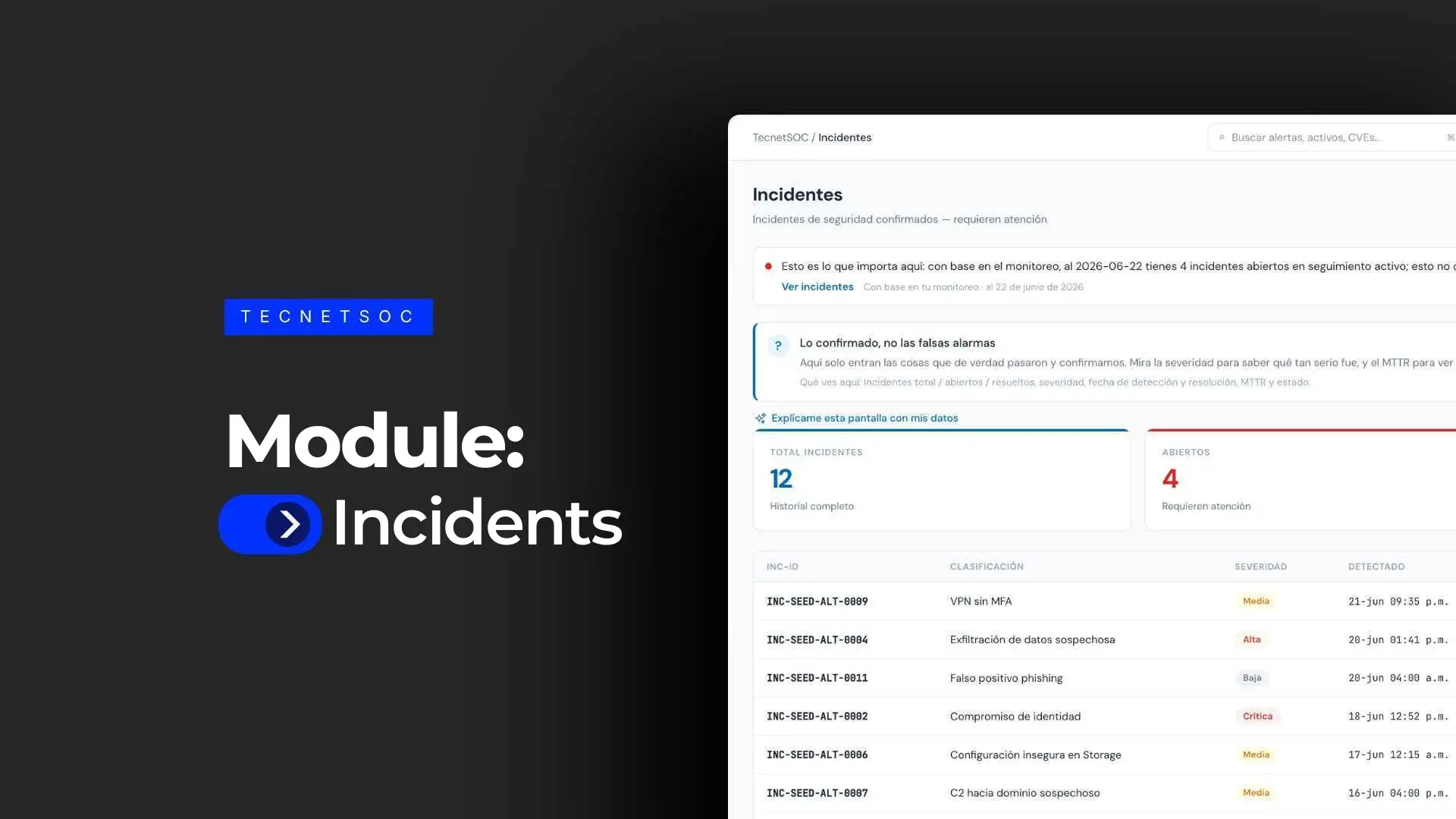
The TecnetSOC Incidents module brings every confirmed security incident into one place and follows it through its full lifecycle. Each incident carries its severity, its MITRE ATT&CK classification, an automatically calculated MTTR and its real-time status, always linked to the investigation that originated it.
It is the piece that organizes security incident management once a threat has been confirmed. Detection is handled by other layers of the security operations center (SOC); this module answers, with precision, the questions that always come afterward: how long it took to close, who handled it, how serious it was and which attack tactic it relates to.
In most teams that information exists, but it is scattered across emails, screenshots and the memory of the on-call analyst. And what is scattered cannot be measured or proven.
When an ISO 27001 audit comes up or a client asks about real response times, the gap between "we fixed it" and "I can show how we fixed it" is exactly what the module closes.
Detection is only the start: the hard part is managing what follows
Detecting a threat is the visible part of a SOC's work, but it is rarely where control slips away. What gets out of hand is the lifecycle that follows. An alert is confirmed as a real incident and, from that point on, a race begins to contain it, resolve it and document it, often without a shared dashboard.
The typical symptom looks like this: the incident was resolved, yes, but nobody can say precisely how long it took, who handled it, how serious it really was or which attack tactic it relates to. The information exists, but it is fragmented. And what is fragmented cannot be measured or improved, let alone proven.
For a company that operates under frameworks such as ISO 27001, or that reports to a client on its security posture, this stops being an operational detail. The question shifts from "did we fix it?" to "can you show how, when and on what basis you fixed it?" That is where well-organized incident management becomes as important as detection itself.
How the TecnetSOC Incidents module works

The module brings every confirmed security incident into the portal and follows it through its entire lifecycle, from the moment it is logged until it is formally closed. Each incident stays linked to the investigation that originated it, so traceability never breaks: you can always go back and understand why that incident exists. This integration is one of the advantages of working with a managed service over building everything in-house, as we covered when comparing an in-house SOC with SOC as a service.
Severity, classification and status: a shared language for every incident
Each incident is logged with a defined severity (critical, high, medium or low), so the team works from one shared priority scale instead of loose interpretations. Classification relies on MITRE ATT&CK (the industry's most widely used framework of attack tactics and techniques) and on threat type, which shows how serious an incident is and also what kind of adversary behavior it relates to.
Status is tracked in real time through each phase of the cycle: open, in progress, resolved and closed. That removes the ambiguity of "I think someone already took care of it." Anyone on the team, or the client, can log in to the portal and see where each incident stands without having to message anyone.
Automatic MTTR: measuring resolution time without spreadsheets
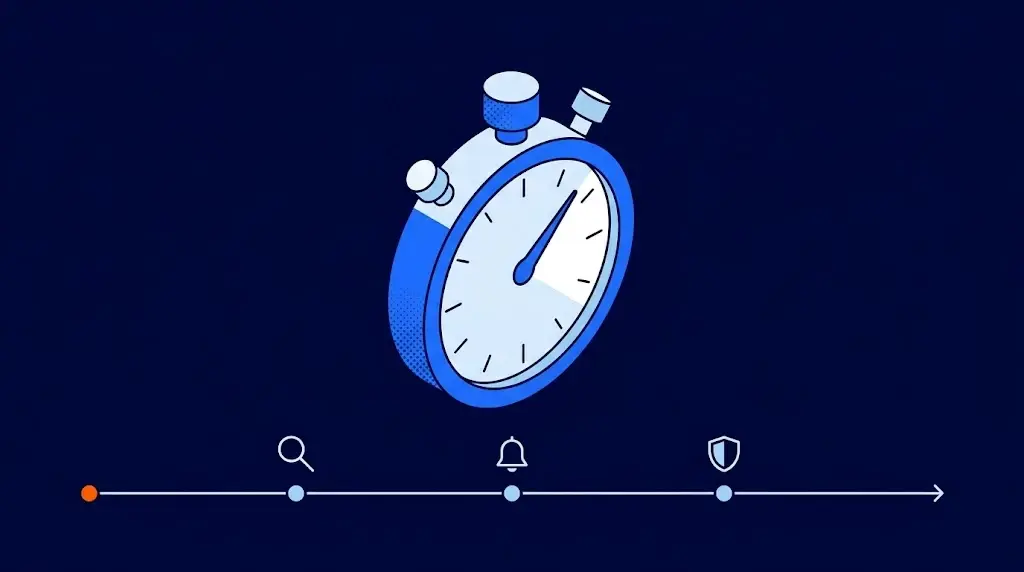
The module automatically calculates the MTTR (mean time to resolve) for each incident, using the detection and closure timestamps the system itself records. That turns a metric usually estimated from memory into real, verifiable data, incident by incident.
MTTR is far more than a vanity number. It is the basis for knowing whether the team is improving over time, spotting which types of incidents take the most work to close and having an honest conversation with leadership or a client about real operating times.
Full history and coordination with the on-call analyst
Each incident keeps its full history with detection and closure timestamps, so the record stays available as evidence you can look up at any time. For active high and critical severity incidents, the module includes direct coordination with the SOC analyst. That way the client is never alone in a serious event: someone on the TecnetOne side supports the process while the incident remains open.
The operational impact: from a loose incident to a traceable cycle
The practical difference between managing incidents with this structure and managing them by hand comes down to control. When every confirmed incident has its severity, classification, status and MTTR in one place, the team stops spending time reconstructing what happened and puts it into resolving what comes next.
For daily operations, this means the company's security status can be read at a glance instead of being pieced together through questions. For leadership, it means having real metrics (how many critical incidents there were, how long they took to close, how MTTR is trending) without relying on someone to compile them by hand every month.

For audit and compliance processes, the value is direct. An incident history with timestamps, severity and classification is exactly the kind of evidence a SOC produces for ISO 27001, PCI DSS or SOC 2 audits.
That structure is also the foundation of a good incident response plan. If you want to know how ready your operation is for that kind of scrutiny, it is worth checking now whether your company could pass a security audit.
Checklist: five questions about your incident management
If you want a quick read on where your handling of confirmed incidents stands today, these five questions will help. The more often you answer "I am not sure," the more value you will get from organizing the lifecycle:
- If someone asks you right now how many critical incidents you had last month, you can answer with an exact number without opening several systems.
- You know how long, on average, it took to close your most recent high-severity incidents.
- Every closed incident records who handled it, when it was detected and when it was closed.
- You can say which attack tactic or technique each recent incident was related to.
- Your team and your client see the same incident status without having to ask each other.
This is the kind of visibility that TecnetSOC builds in natively, alongside detection, investigation and continuous monitoring.


Microsoft Cloud and Cybersecurity expert with more than a decade of experience in the technology industry. He is recognized for his extensive knowledge in implementing cloud-based solutions and protecting data and systems against cyber threats. As a leader and speaker, Gustavo continues to share his knowledge and best practices at technology events and training programs.